In a country widely admired for its technological advancement, ultra-fast internet, and smart cities, South Korea today is grappling with one of its most sensitive and complex social issues: the rise of digital sex crimes and the widespread leaking of private footage through hacked smart cameras. Although South Korea has long been seen as a pioneer of digital innovation, the same technology has created a new environment filled with legal, ethical, and social challenges. How the Crisis Began: When Smart Tech Becomes a Threat Over the past months, Korean media has been shaken by shocking revelations: Tens of thousands of private clips—captured through home security cameras, office cameras, and even hotel devices—were leaked and sold through hidden online networks. The real shock was not just the existence of these videos, but the scale of the breach and how easily hackers were able to access devices used daily by millions of people. Why This Is Not Just a Crime, But a Social Issue Beca...
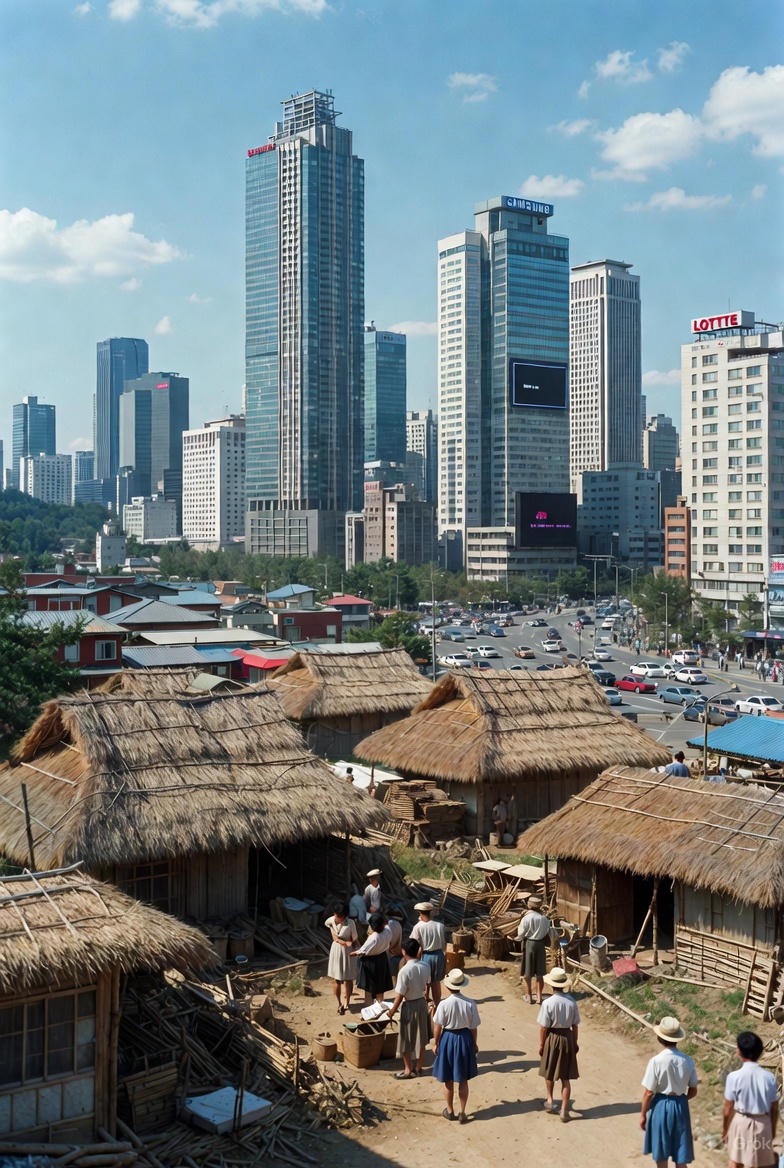
How South Korea Went from the Poorest Country on Earth to a Global Tech Superpower in Just One Generation?
Published: December 6, 2025
In 1960, South Korea was poorer than most of today’s African nations.
Its GDP per capita was $79 (about $850 in today’s money).
People ate tree bark soup during famines.
Children walked barefoot to school—if they went at all.
The country had no natural resources, no capital, no technology, and had just emerged from a devastating war that left two million dead and almost every factory, bridge, and railway in ruins.
Today, in 2025, South Korea:
- Has the world’s 10th-largest economy
- Produces 70% of global memory chips
- Builds the biggest ships on the planet
- Has the fastest average internet speed (twice as fast as the US)
- Invented the smartphone foldable screen, 5 nm chips, and the most advanced batteries
- Exports more culture (K-pop, dramas, games) than France exports wine and fashion combined
How did a country with literally nothing become one of the richest, most innovative, and most culturally powerful nations in just 60 years—one single human lifetime?
This is the real story.
Phase 1: 1960–1972 – “We have nothing but our hands and our will”
When Park Chung-hee took power in a military coup in 1961, he asked his economic planners one question:
“What is the fastest way to stop people from starving?”
The answer was brutal but simple: export anything, anywhere, at any price.
- 1962: First five-year plan launched
- Farmers were forced to grow specific crops and sell them to the government at fixed prices
- Young women were sent to work in textile factories 16 hours a day for $0.10 an hour
- The government picked “national champion” companies (Samsung, Hyundai, LG) and gave them cheap loans, tax breaks, and monopoly rights
- In return, they had to export—or die
Samsung started by exporting dried fish and vegetables.
Hyundai’s first big contract was building a highway in Thailand because no Korean road needed it yet.
By 1970, South Korea was the world’s fastest-growing economy—13% annual growth.
Phase 2: 1973–1979 – The Heavy Industry Gamble
Park decided textiles and wigs (yes, Korea was once the world’s largest wig exporter) weren’t enough.
He wanted steel, ships, cars, and chemicals.
He borrowed billions from Japan and the West at crazy interest rates and forced the chaebols to build:
- POSCO (now the world’s 6th-largest steel maker) – built from scratch in 4 years
- Ulsan shipyard (Hyundai Heavy Industries) – today the largest shipyard on Earth
- The Gyeongbu Expressway (Seoul–Busan high-speed railway and highway) – finished in record time by soldiers and students working for food rations
People called it madness. The World Bank refused to fund POSCO because “Korea has no iron ore or coal.”
Park replied: “We’ll import everything and export steel at a loss until we learn how to do it better.”
They did.
Phase 3: 1980–1997 – Blood, Sweat, and Samsung
After Park’s assassination in 1979, another general took over, but the machine kept running.
- Workers worked 60–70 hours a week (still among the longest hours in the OECD today)
- Students studied until 1 a.m. in hagwons (cram schools)
- The government banned luxury imports: if you wanted a color TV, you had to buy a Korean one
- In 1988, Seoul hosted the Olympics—Korea announced to the world: “We have arrived.”
By 1996, Korea joined the OECD. The miracle was complete.
Then came the 1997 crisis that almost destroyed everything (but that’s another story).
Phase 4: 1998–2025 – From Imitation to Innovation
After the IMF crisis forced painful reforms, something unexpected happened: Korea stopped copying and started inventing.
- 2000s: Samsung decides to beat Sony at TVs and Nokia at phones
- 2010s: Korea invents the curved screen, the foldable phone, the 5G network
- 2020s: Korean batteries power 70% of electric cars worldwide; Korean chips are inside every AI server
Today:
- 1 out of every 7 patents filed globally in AI, batteries, and semiconductors comes from Korea
- Korean startups raised more venture capital in 2024 than Germany and France combined
- A single Korean company (Samsung Electronics) has a bigger R&D budget than the entire country of Italy
The Real Secret Nobody Talks About
It wasn’t just hard work.
It was a national obsession with education and future generations.
In the 1970s, poor farmers sold their cows to send their kids to school.
In the 1980s, factory workers lived in tiny rooms so their children could go to university.
In the 1990s, parents spent 15% of their income on private tutoring.
Today, 70% of Koreans aged 25–34 have a university degree—the highest rate in the world.
They didn’t just build factories.
They built human capital.
The Price
Yes, there was a dark side: authoritarian rule, crushed labor unions, environmental destruction, insane competition, and a suicide rate that is still among the highest in the developed world.
But when Koreans look back, most say the same thing:
“We had no choice. It was survive or disappear.”
The Lesson
South Korea proves that extreme poverty is not destiny.
A country with no oil, no minerals, no land, no legacy of wealth, surrounded by enemies and destroyed by war, can become a global superpower in one lifetime—if its people decide that the future of their children is worth any sacrifice today.
In 1960, a Korean earned less than a Ghanaian.
In 2025, a Korean earns more than a Spaniard or an Italian.
That didn’t happen because of luck, foreign aid, or natural resources.
It happened because a nation decided, collectively and painfully, to bet everything on tomorrow.
And tomorrow came.
Comments